Showing posts with label math. Show all posts
Showing posts with label math. Show all posts
Saturday, January 8, 2011
The Joy of Stats
I am currently geeking out over this video that was shared with me by a couple friends, so today, I share it with you.


Wednesday, September 24, 2008
Moving on
 OpArt is finished and on it's way to California (via Florida). The pattern was tons of fun to make and it was idea for an i-cord border. Since it is worked from the center out all of my live stitches were the outside edge. I just bound them off with the icord and managed to skip the bind off and the pick up stitches steps. I knit the blanket on US6 needles but did the i-cord on US8. It gave me a wonderfully stretchy border that allowed for the massive blocking.
Since I can't tell you about the super secret Christmas knitting, I'll share my new project. Granted it is so new that I haven't even cast on yet. I don't know if it was the m
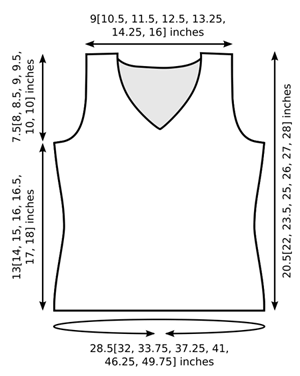 obiuses (what is the plural of that word? mobei?) that gave me confidence or what, but I am taking on a project with sleeves. The pattern is Francis Revisited by Beth Silverstein. It is knit in the round top down, so there isn't much as far as seeming and probably as easy as you can get as far as including sleeves is concerned. My gauge swatch finished drying along with the blanket, and I've finished all the math (well I think I've finished it anyway). Some patterns come with a little drawing at the end of the item with all of its measurements. Here is an example from the Abrazo pattern from the current Knitty.
These pictures are particularly useful to women like me who don't fit into any one particular size of women's apparel. For example (depending on the sizing) my shoulders might fit into a medium, my bust into a large, my waist into a small, and my hips into an xlarge. The little chart lets me check finished garment's measurements against my measurements. Francis didn't have one of these, so I decided to go ahead and make one.
 I started with a lightly drawn rough sketch of what I thought the sweater was going to look like, and then I went though the pattern step by step and added the heavier straight lines and measurements for what was actually going to be happening. It doesn't look that pretty (in fact, it kind of reminds me of Frankenstein's monster) and it certainly isn't to scale or accurate as a drawing, but it has already been worth every moment I spent on it.
 First, I realized that the instructions for my size would give me a pretty consistent 2 inches of positive ease. Right up until the hips, then just fits with no ease. I knew I had to add in two more increase rows and because I went through the pattern I knew where they would fit easily to keep the gradual flaring after the waist. I also figured out how many rows should fit in the sections that say knit until X inches long. Finally, it has given me some forewarning that it may be a little sort under the arm pits and I'll have to check the fit when I join for knitting in the round there. It has kept me from playing with fiber, but this was so useful, that I may make one of these even if the pattern comes with a little drawing.
Thursday, September 18, 2008
Mobius Fun
At my Tuesday night knitting group, one of the women was making a mobius wrap. I have seen a lot of these and I even have one that I want to make in my queue. The one she is making has colored stripes in it and she was showing us how she was slightly disappointed that the wrong side of the knitting was going to be showing. The math loving male knitter that is a part of the group piped up to remind us that there is no wrong side because a mobius strip only has one side.
At first, I just brushed it off as a terminology discrepancy. A Mobius Strip is cool because it does only have one side, but in knitting there is a right side and a wrong side. The knitting use of the word 'side' doesn't rely at all on the mathematic definition of a 'side' that is important to the mobius concept. Sometimes in knitting the right side and the wrong side look exactly alike, but where there are color changes like the ones in her wrap there is a difference. I've been showing you pictures of the right side of the baby blanket I am making but here is a picture of the wrong side. The color changes are not nearly as tidy on the wrong side and this is what is showing on her wrap.
Despite thinking it was a communication issue, I couldn't get over this dilemma. I know that knitting is heavily math based, and I know that I've read about knitting mobius strips as wraps and scarves. I just felt like we were missing something about how they work and how they are knitted up. Yesterday I decided to call on an authority and had my hubby teach me what he could about mobius strips. We got all excited and cut up strips of paper both to make a strip and to try and figure out where the 'wrong side' was showing on the shawl. (Keeping with the theme, all of these strips were made out of the Knit Picks receipt I had sitting on my desk.)
I haven't gotten to see her wrap since yesterday to verify, but I think I may have discovered the source of the dilemma. She told me that knitted mobius's are really easy to make. you knit in the round like you would any tube but before you join you twist the stitches. As you knit the tube gets longer, and it has a twist in it. I think the problem is that this is not a mobius strip. Rather it is a loop with a twist in it. A mobius strip only has half a twist. A twisted loop is still really cool, because you cannot untwist it, but there are still two different sides and two different edges. In the case of what she is knitting she cast on one edge and she is knitting each row to the other edge. A mobius strip cannot work that way because it only has one edge.
As Mike and I tried to figure it out, I looked up the mobius scarf patterns that I knew of. They came in two varieties. One was a twisted loop and not a genuine mobius. The others were constructed the same way you make one with a piece of paper. They were knit up back and forth like a regular scarf, then given a twist, and the ends were sewn together. They were authentic mobius strips, but where's the fun in knitting it like that.:P
We played with paper strips some more and I cast on a couple of disasters trying to figure the puzzle out, and the real dilemma turned out to be the one edge. When you knit, you make something one row at a time which means you are adding to one edge. The Mobius is troublesome because it only has one edge, but that edge is twice as long as the strip from which it is made; or twice as many stitches as you would actually want your thing to go around. Mike figured it out that your cast on edge for a knit mobius strip would actually have to be the center of the finished object. So you would actually knit the strip from the center out.
If you look at this picture, the cast on would be the orange stripe. Row one would be the blue stripe, and the purple stripe is row two. It would continue to work outward like that for as long as you wanted.
How to Make a Mobius Strip
This is in no way a pattern but rather just a talk though of the conceptual stuff.
First, you cast on the number of stitches that would determine the right size of your loop. Basically the number of stitches that would make a tube of the right size plus a few to accommodate the twist.
Then you need to join them like knitting in the round, but instead of knitting the stitches like you would for a regular tube, you pick up stitches from that cast on edge. This would give you two sets of live stitches facing opposite directions from the cast on. This is how you get twice as many stitches. When you knit them up, it is like knitting two different loops (one above the cast on and one below) but they are connect and that connection makes the twist.

Here is the one I made. The most trouble I had with it was that it was really small to work with. I only used knit stitches, but as you can see the bottom half is stockinette, and the top half is reverse stockinette. I think that is because those stitches are facing in different directions. I think to fix that you would just have to purl the second half of every round. I want to try it again both to figure out how to make it all stockinette on the 'outside' and I need to make one with a colored stripe in it to see if it would fix the 'wrong side' issue. Until then if you know of any barbies with cold shoulders, I have a wrap that would suit them just fine.
I had a ton of fun working on this with Mike yesterday. I learned a lot and it really inspired my knitting. We did completely reinvent the wheel though. I eventually found a pattern for a scarf that is conceptually knit up the same way as my little practice piece. It doesn't matter though, because a couple hours after we figured it out, Mike sat me down and asked me to teach him how to knit! He's pretty good for a beginner. I'm going to have to put him to work.
At first, I just brushed it off as a terminology discrepancy. A Mobius Strip is cool because it does only have one side, but in knitting there is a right side and a wrong side. The knitting use of the word 'side' doesn't rely at all on the mathematic definition of a 'side' that is important to the mobius concept. Sometimes in knitting the right side and the wrong side look exactly alike, but where there are color changes like the ones in her wrap there is a difference.
 I've been showing you pictures of the right side of the baby blanket I am making but here is a picture of the wrong side. The color changes are not nearly as tidy on the wrong side and this is what is showing on her wrap.
Despite thinking it was a communication issue, I couldn't get over this dilemma. I know that knitting is heavily math based, and I know that I've read about knitting mobius strips as wraps and scarves.
 I just felt like we were missing something about how they work and how they are knitted up. Yesterday I decided to call on an authority and had my hubby teach me what he could about mobius strips. We got all excited and cut up strips of paper both to make a strip and to try and figure out where the 'wrong side' was showing on the shawl. (Keeping with the theme, all of these strips were made out of the Knit Picks receipt I had sitting on my desk.)
I haven't gotten to see her wrap since yesterday to verify, but I think I may have discovered the source of the dilemma. She told me that knitted mobius's are really easy to make. you knit in the round like you would any tube but before you join you twist the stitches. As you knit the tube gets longer, and it has a twist in it. I think the problem is that this is not a mobius strip. Rather it is a loop with a twist in it. A mobius strip only has half a twist. A twisted loop is still really cool, because you cannot untwist it, but there are still two different sides and two different edges. In the case of what she is knitting she cast on one edge and she is knitting each row to the other edge. A mobius strip cannot work that way because it only has one edge.
As Mike and I tried to figure it out, I looked up the mobius scarf patterns that I knew of. They came in two varieties. One was a twisted loop and not a genuine mobius. The others were constructed the same way you make one with a piece of paper. They were knit up back and forth like a regular scarf, then given a twist, and the ends were sewn together. They were authentic mobius strips, but where's the fun in knitting it like that.:P
We played with paper strips some more and I cast on a couple of disasters trying to figure the puzzle out, and the real dilemma turned out to be the one edge. When you knit, you make something one row at a time which means you are adding to one edge. The Mobius is troublesome because it only has one edge, but that edge is twice as long as the strip from which it is made; or twice as many stitches as you would actually want your thing to go around. Mike figured it out that your cast on edge for a knit mobius strip would actually have to be the center of the finished object.
 So you would actually knit the strip from the center out.
If you look at this picture, the cast on would be the orange stripe. Row one would be the blue stripe, and the purple stripe is row two. It would continue to work outward like that for as long as you wanted.
How to Make a Mobius Strip
This is in no way a pattern but rather just a talk though of the conceptual stuff.
First, you cast on the number of stitches that would determine the right size of your loop. Basically the number of stitches that would make a tube of the right size plus a few to accommodate the twist.
Then you need to join them like knitting in the round, but instead of knitting the stitches like you would for a regular tube, you pick up stitches from that cast on edge. This would give you two sets of live stitches facing opposite directions from the cast on. This is how you get twice as many stitches. When you knit them up, it is like knitting two different loops (one above the cast on and one below) but they are connect and that connection makes the twist.

Here is the one I made. The most trouble I had with it was that it was really small to work with. I only used knit stitches, but as you can see the bottom half is stockinette, and the top half is reverse stockinette. I think that is because those stitches are facing in different directions. I think to fix that you would just have to purl the second half of every round. I want to try it again both to figure out how to make it all stockinette on the 'outside' and I need to make one with a colored stripe in it to see if it would fix the 'wrong side' issue. Until then if you know of any barbies with cold shoulders, I have a wrap that would suit them just fine.
I had a ton of fun working on this with Mike yesterday. I learned a lot and it really inspired my knitting. We did completely reinvent the wheel though. I eventually found a pattern for a scarf that is conceptually knit up the same way as my little practice piece. It doesn't matter though, because a couple hours after we figured it out, Mike sat me down and asked me to teach him how to knit! He's pretty good for a beginner. I'm going to have to put him to work.

Thursday, September 11, 2008
Mathmagic Land
So I've been thinking more about these two patterns, their differences, and which would better suite my friend. My hubby pointed out that Curve of Pursuit is the way to go for a math lover. He started telling me about spirals in nature and whatnot. Then he referenced Donald in Mathmagic Land. In the name of knitting we bonded over a fantastic (though a bit trippy) Disney classic.
You can check out the other 2 sections for some mathematics in chess and a billiards lesson that makes me think even I could do it. This was clearly an influencing part of his childhood. Watching it, I felt like I was being brought back in time to one of those indoctrinating moments where the secrets of the world were unlocked for my (childhood) hubby. What cartoons or characters influenced you as a kid?
Don't forget to let me know what blanket you like better. I'll see if I can dig something up on optical illusions so that the Curve of Pursuit won't have an unfair advantage over OpArt.
You can check out the other 2 sections for some mathematics in chess and a billiards lesson that makes me think even I could do it. This was clearly an influencing part of his childhood. Watching it, I felt like I was being brought back in time to one of those indoctrinating moments where the secrets of the world were unlocked for my (childhood) hubby. What cartoons or characters influenced you as a kid?
Don't forget to let me know what blanket you like better. I'll see if I can dig something up on optical illusions so that the Curve of Pursuit won't have an unfair advantage over OpArt.
Subscribe to:
Posts (Atom)